
GULFSTREAM, Trinidad and Tobago, 2024
6 February 2024
Incident
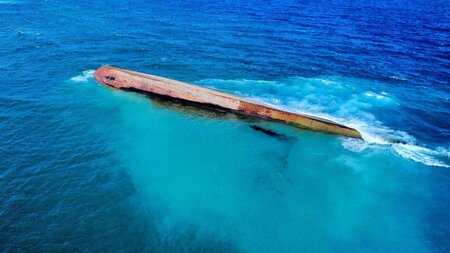
On 6th February 2024, the articulated tank barge GULFSTREAM, towed by the tug SOLO CREED, capsized off the coast of Tobago. The barge grounded ~150 m offshore of Canoe Bay, on the southernmost tip of the island. It released an unknown quantity of Heavy Fuel Oil, with multiple sources suggesting varying volumes, however the IOPC Funds estimates the spilled volume to be 4,652 MT. Satellite imagery suggests that the barge had been leaking oil since at least 3rd February 2024, after reportedly departing from Pozuelos Bay, Venezuela bound for Guyana. The owner of the vessel is unknown.
Following the capsizing and subsequent grounding, heavy oiling extended from the grounding location across a 15 km stretch of shoreline, from Cove Reef to Scarborough on the Atlantic coastline of Tobago. Affected areas contained mangroves, rip-rap, river mouths and extensive sandy beaches. Bonaire (Kingdom of the Netherlands) reported the presence of tar balls on some beaches.
Response
The clean-up began on 8th February 2024, involving ~200 people, of which ~50% were volunteers. Contractors included Trinidad and Tobago’s state-owned oil company, local responders and waste contractors with support from specialist international organisations.
Bulk oil removal on the shoreline comprised manual clean-up strategies, with mechanical assistance comprising vacuum trucks and excavators. At sea, deflection booms were deployed to protect sensitive areas (eg mangroves); however, adverse metocean conditions coupled with shallow water depths reduced the effectiveness of these strategies. Spring tides and heavy weather at the time of the incident pushed the oil above the mean high-water line, resulting in a reduction of natural attenuation in these areas.
Residual oil removal focused on high-volume, low-pressure flushing, undertaken on rocky beaches to remove oil trapped within the rocks as well as sunken oil from river mouths and in mangrove areas. High-pressure washing was used on manmade structures and in amenity areas in Scarborough.
Oiled waste generated during the response was temporarily stored at Studley Park landfill site, however, as of September 2025, a final disposal solution has yet to be determined.
Clean-up operations concluded on 21st April 2024, with resources demobilised shortly thereafter.
Rijkswaterstaat (a subsidiary of the Dutch Ministry of Infrastructure and Water Management) orchestrated the clean-up of the oil-impacted shorelines on Bonaire.
Salvage operations involved the removal of 5,195 MT of oil from the wreck by US-based salvors, and transfer to Trinidad for sale and reuse, with ~400 bbl remaining on board the wreck. The vessel was subsequently refloated in August 2024 and towed to Port of Spain, Trinidad for final cleaning and disposal.
Claims and compensation
Trinidad and Tobago is a signatory to the 1992 Civil Liability and Fund Conventions. Given the GULFSTREAM’s lack of shipowner, insurance and the vessel being an unpowered barge, it was initially not clear as to whether these conventions would apply. However, IOPC Fund Member States agreed at their April 2024 meeting to authorise the Fund’s Director to provide compensation up to the 1992 Fund limit of SDR 203 million (~UK £213 million).
ITOPF involvement
ITOPF was mobilised at the request of the IOPC Funds on 22nd February 2024, arriving on site on 25th February, 18 days after the initial capsize and grounding. Technical staff remained on site until 27th April 2024. ITOPF staff integrated readily into the command structure. At the request of the IOPC Funds, ITOPF undertook additional site visits in May and October 2024 and September 2025.
While on site, ITOPF provided advice to the authorities: Tobago Emergency Management Agency (TEMA), the Tobago House of Assembly (THA) and the Ministry of Energy and Energy Industries (MEEI), as well as clean-up contractors. Technical advice included site prioritisation, contractor oversight, appropriate clean-up techniques, defining end points and identifying waste management solutions. Technical Advisers also collected oil samples and facilitated their transfer for analysis, which in turn confirmed that the spilled oil was persistent and therefore a contributing oil under the IOPC Funds' definition.
As of September 2025, 357 claims had been submitted to the IOPC Funds for compensation, of which approximately half relate to clean-up operations and half relate to reported fisheries' losses. ITOPF began reviewing claims and providing assessments to IOPC Funds in August 2024 when the first submissions were made. As of December 2025, ITOPF has assessed the majority of clean-up claims, although further claims may yet be submitted.
Categories: West Indies, Oil, Barge, Americas