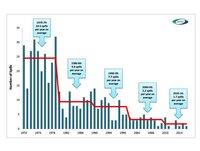
For the last four and a half decades the average number of large oil spills from tankers, i.e. greater than 700 tonnes, has progressively reduced and since 2010 averages 1.7 per year.
Industry leaders and experts gathered in London to discuss the latest in Environmental, Social and Governance (ESG) trends in relation to ship-source spill response, at an event hosted by ITOPF.
ITOPF spent time in China with the Shanghai Maritime Safety Administration (MSA), where it hosted a workshop on responding to incidents of ship-source pollution at-sea and on shorelines.
This paper provides a global overview of the spatial distribution of accidental marine oil tanker spills of size 7 tonnes and over, based on ITOPF’s spills database, and explores spatio-temporal
An exhibition charting 50 years of cooperation between government and industry for the safe transport of oil by sea was opened on Monday 16th January at the headquarters of the IMO.
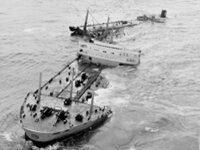
TORREY CANYON ran aground on Pollard Rock on the Seven Stones Reef, near Lands End, Cornwall on 18th March 1967. Thousands of tonnes of oil were soon spilling from the stricken vessel's ruptured