Search

Please use this search facility to search all content found within the website:

Search words under length of 4 characters are not processed.

801 results:

Falkland Islands

… aircraft for this purpose. Any…

ITOPF Publishes Annual Review 2015

ITOPF Publishes Annual Review 2015

ITOPF has just published its Annual Review and Accounts for 2015

Training, table-top exercises and more at the World Maritime University

Training, table-top exercises and more at the World Maritime University

As part of our continued outreach programme, we visited the World Maritime University (WMU) in Malmo, Sweden to deliver training exercises and presentations to Masters students.

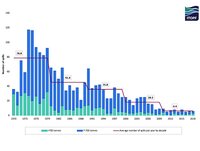
2018 Tanker Oil Spill Statistics: Number of spills remains low

2018 Tanker Oil Spill Statistics: Number of spills remains low

For close to five decades, the frequency of oil spills from tankers has shown a progressive downward trend.

When should clean-up operations be brought to a close - How clean is clean? (1998)

When should clean-up operations be brought to a close - How clean is clean? (1998)

At the outset of a major oil spill, it is hard to imagine how shorelines inundated with the thick black pollutant will ever be cleaned or that they will ever return to their original condition. Two

ITOPF welcomes Lynn Leslie and Khalish Ideris

ITOPF welcomes Lynn Leslie and Khalish Ideris

We are delighted to welcome two new members to the ITOPF Team in Lynn Leslie and Khalish Ideris.

SeaRiver Maritime 2014 Prince William Sound Oil Spill Exercise

SeaRiver Maritime 2014 Prince William Sound Oil Spill Exercise

ITOPF participated in a Tier 3 oil spill exercise organised by SeaRiver Maritime Inc in Alaska.

ITOPF wins Lloyd’s List Global Award

ITOPF wins Lloyd’s List Global Award

ITOPF was the winner in the category for best Environmental Programme at the Lloyd’s List Global Awards event last night.

Comparison and assessment of waste generated during oil spills (2014)

Comparison and assessment of waste generated during oil spills (2014)

Experience has shown that the most time-consuming and costly component of a response to an oil spill is often the treatment or disposal of collected waste. The amount of waste generated is dependent